


What Is MOZ Domain Authority (DA)
Domain Authority (DA) is a search engine ranking score that predicts how likely a website is to rank on search engine result pages (SERPs). Domain Authority scores range from 1 to 100 — the higher the score, the greater the likelihood of ranking.
The MOZ DA score is based on data from the reliable Link Explorer web index and uses dozens of factors in its calculations. The calculation uses a machine learning model to predict the “best” algorithm for the most accurate correlation of link data with rankings across thousands of actual search results.
How do you know if your Domain Authority score is good? First, it’s important to understand that a brand new website will always start with a DA score of one. It will gradually increase as the site earns more authoritative backlinks over time. There is no single target number that applies to all sites — a good score is determined based on your resources, your competitors, and your specific ranking goals. A common mistake is to treat DA as a fixed score. In reality, it is dynamic.
As a general guideline: scores below 15–20 on Moz indicate room for improvement, while scores between 40 and 70 are considered good based on both Moz and Semrush algorithms. It’s important to remember that sites with many high-quality external links will have higher Domain Authority, while websites with fewer inbound links may have significantly lower DA scores.
How to Check Domain Authority (DA)
The fastest way to check the domain authority of any website is to use Moz Link Explorer. You’ll need to create a free Moz Community account — and with just one click you’ll get access to all key metrics.
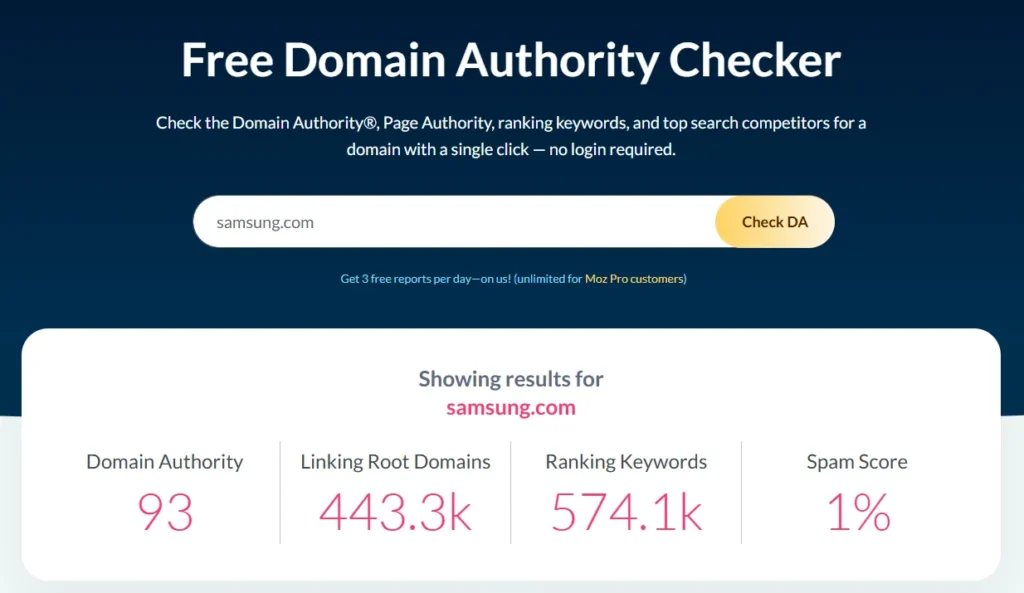
Why check Domain Authority? It’s a time-saving way to quickly assess your competitive position, gather important SEO information about competitors, potential clients, and partners. Competitor analysis is a key component of any SEO strategy, and tracking the right competitors is crucial for success. DA also helps you identify problem areas for potential clients and better present yourself by addressing them.
DA Metrics
MOZ DA metrics include over 40 factors that make up the scoring algorithm. The exact formula is not disclosed, but the main Domain Authority indicators include:
1. Quality and quantity of backlinks.
- Number of referring domains: the more unique sites link to you, the better.
- Link quality: a few links from authoritative sites are worth more than hundreds from low-quality resources.
- Link naturalness: Google and Moz reduce the weight of artificial or spammy links.
- Dofollow vs. Nofollow: only dofollow links affect DA.
2. Domain age. Sites that have existed for a long time generally have higher DA if they are consistently updated.
3. Content quality. Useful, unique, and well-structured content improves user engagement and natural link building. Greater article length and depth positively affects site authority.
4. Site SEO health.
- Optimization of meta tags, headings, and URL structure.
- Absence of technical errors: broken links, 404 pages, slow load times.
- Internal linking (quality interconnection of pages within the site).
5. Spam score. Moz has a Spam Score that determines how suspicious a site looks to search engines. A high spam score (due to toxic backlinks or unnatural SEO practices) can lower DA.
6. Social signals (indirect factor). Moz doesn’t directly factor in social media, but frequent sharing on Facebook, Twitter, and LinkedIn can lead to earning quality backlinks.
7. Overall niche authority. If a site operates in a highly competitive niche (e.g. finance, medicine), its DA will depend on how it compares to competitors in that space.
What Is MOZ Page Authority (PA)
Page Authority (PA) is a score that predicts how well a specific web page will rank on search engine result pages (SERPs). Like DA, it uses a machine learning model to identify the algorithm that best correlates with rankings across thousands of search results. PA scores also range from 1 to 100.
A good MOZ PA score generally falls between 30 and 70 — the more precise figure depends on competition in the industry. PA is an important indicator of a page’s ranking potential in search engines. You can improve SEO and influence Page Authority by improving a page’s link profile — by earning external links from other authoritative pages, which act as “votes of confidence” for your page’s authority.
How to Check Page Authority (PA)
You can get the PA of any page on your website for free. To check PA, go to Moz Link Explorer and enter the address of any page you want to review. Click the button next to the search window. If you haven’t created a free Moz Community account yet, you’ll be prompted to do so. Once logged in, you can quickly get useful data from Link Explorer for any URL you enter.
Moz Link Explorer is also available as a free Chrome extension that gives you instant access to metrics such as Page Authority, Domain Authority, and Spam Score.
Why check Page Authority? It’s an important metric that helps identify growth opportunities, analyze competitors, track changes over time, and compare different pages. Like all SEO metrics, it has many applications: it helps assess current status, make improvement decisions, and verify whether those actions produced results. High Page Authority is key for marketers as it indicates a page’s potential visibility in search engines — which can lead to increased traffic and stronger brand trust.
PA Metrics
MOZ PA scores are influenced by dozens of factors, including but not limited to:
- linking URL addresses;
- linking root domains;
- subdomain connections;
- MozTrust + MozRank;
- followed links;
- nofollowed links;
- link anchor text distribution;
- 301 and 302 redirect status;
- new and old links;
- top-level domains (TLD);
- domain names;
- branded mentions;
- spam score, and more.
As we can see, the main Page Authority indicators are link-oriented. Using links to approximate page popularity was a significant part of Google’s original algorithm. Much has changed since then, but links remain a vital component even today.
How to Improve Overall Website Authority
Website authority is a metric that reflects a site’s overall reputation and SEO effectiveness. It helps assess the likelihood of a site ranking well in search results. Increasing Domain Authority improves a resource’s visibility, as search engines — particularly Google — favor reliable and established sites. High website authority (90–100) is often associated with well-known companies such as Google, Amazon, and Apple.
How to improve website authority:
- Earn quality backlinks through valuable content.
- Grow organic traffic with optimized content.
- Monitor and disavow bad links.
- Build a strong internal linking strategy.
- List your website in relevant directories.
Conclusion
To summarize: while Page Authority (PA) measures the predictive ranking strength of a single page, Domain Authority (DA) measures the strength of entire domains or subdomains. Their scores are calculated using the same methodology, which makes them very similar in many ways. Their key shared value is that both metrics allow you to quickly identify the strengths and weaknesses of your site and competitors, adjust your SEO strategy, improve rankings, and attract new clients or readers.